




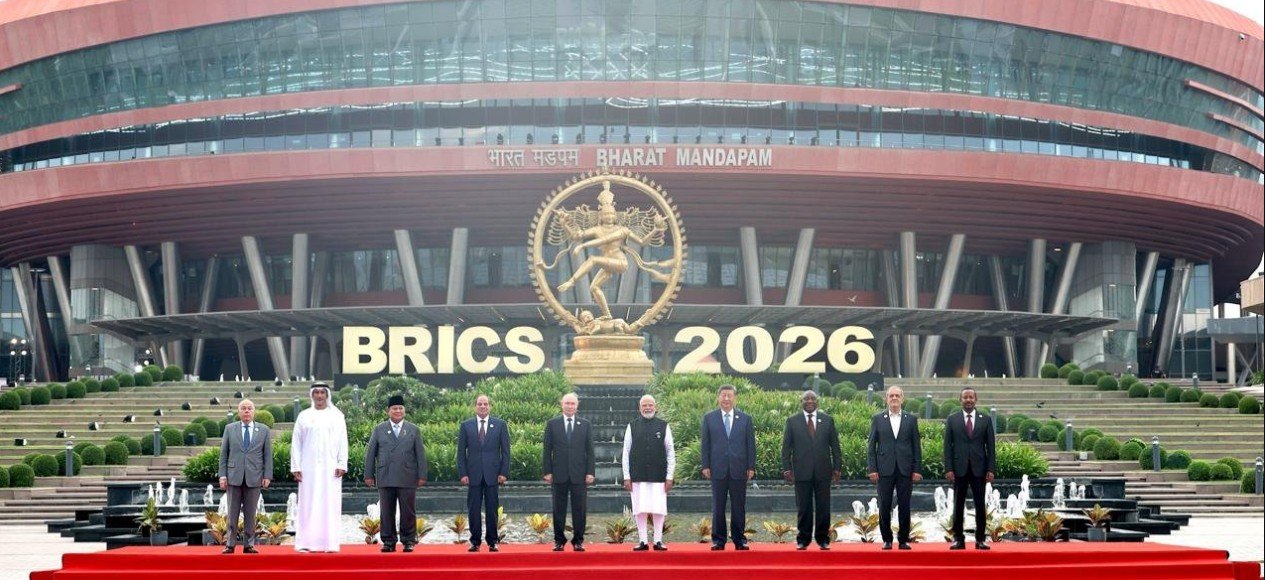
New Delhi, September 12: Prime Minister Narendra Modi on Saturday announced the unanimous adoption of the New Delhi Declaration 2026 at the 18th BRICS Summit in New Delhi. “No member has raised any objection. The New Delhi Declaration 2026 is adopted unanimously,” PM Modi said.
The 140-point declaration called for conflict prevention through dialogue and diplomacy and backed a multilateral approach that respects different national positions. It also raised concerns over unilateral tariff and non-tariff measures that distort trade and violate WTO rules.
The declaration was finalised after negotiations continued until the early hours of Saturday, with India working to bridge differences among members, including over issues related to West Asia. India is hosting the summit under the theme “Building for Resilience, Innovation, Cooperation and Sustainability.”
Here are the key takeaways from the same:
1. Concern over ongoing conflicts
BRICS leaders expressed concern over ongoing conflicts in several parts of the world, as well as the growing polarisation and fragmentation of the international order. The declaration also raised alarm over the sharp increase in global military spending, saying it comes at the cost of adequate development financing for developing countries.
2. Comprehensive UN and Security Council reform
BRICS leaders called for reforms to the United Nations system to strengthen the voice of the Global South. Permanent Security Council members China and Russia reiterated their support for Brazil and India to have a greater role in the UN, including its Security Council.
3. Reform of global financial institutions
The declaration highlighted the urgent need to reform the Bretton Woods Institutions, including the IMF and World Bank, to increase the quota shares, voting power and leadership representation of Emerging Markets and Developing Economies.
4. Local currency trade and payment interoperability
The BRICS Payment Task Force is studying cross-border messaging and payment channel interoperability while working to advance trade settlements and investments in BRICS local currencies.
5. Restoration of the WTO dispute mechanism
BRICS supported an open and rules-based multilateral trading system and called for the immediate restoration of a fully functioning, two-tier binding WTO dispute settlement mechanism, along with the prompt appointment of Appellate Body members.
6. Rejection of unilateral sanctions and carbon tariffs
BRICS strongly condemned unilateral coercive economic sanctions, secondary sanctions and protectionist measures presented as environmental policies, including carbon border adjustment mechanisms.
7. Gaza ceasefire and two-state solution
The summit called for adherence to ceasefire agreements and unhindered humanitarian access in Gaza. It also reaffirmed support for a sovereign and independent Palestinian state based on the 1967 borders under a two-state solution.
8. Zero tolerance for terrorism
The declaration strongly condemned terrorism in all forms and without double standards. It specifically cited the April 22, 2025 terrorist attack in Jammu and Kashmir’s Pahalgam and called for action against cross-border terrorist movements and safe havens.
9. Artificial intelligence and digital public infrastructure
BRICS leaders committed to implementing the BRICS Leaders’ Statement on the Global Governance of Artificial Intelligence to promote safe and trustworthy AI. They also backed the development of Digital Public Infrastructure repositories and solutions.
10. Climate commitments and diversified energy mix
The declaration reaffirmed the Paris Agreement based on the principle of common but differentiated responsibilities. BRICS members prioritised energy security through balanced and diversified energy mixes covering renewables, nuclear power, bioenergy, fossil fuels and low-emissions hydrogen.
Also Read: RBI To Sell Government Securities Worth Rs 1 Lakh Crore Amid Liquidity Surge